
Most of the risks that hit a company are visible somewhere before they materialise. A supplier’s financial trouble shows up in registry filings. A protest against a facility is organised openly on social media. Stolen employee credentials appear on a criminal forum weeks before an intrusion. A fake website impersonating the brand goes live days before a phishing campaign.
OSINT for corporate security is the use of open-source information and publicly available data to identify, assess and mitigate risks to a company’s people, operations, assets or reputation. Its core promise is simple: it allows organisations to anticipate threats, uncover hidden risks and make informed security decisions. This article breaks down the eight use cases in the OSINT for Corporate Security cheat sheet and the kinds of tools that support each one.
At Cibergy, an intelligence and fraud consulting firm, we tell you everything you need to know about OSINT for corporate security, step by step.
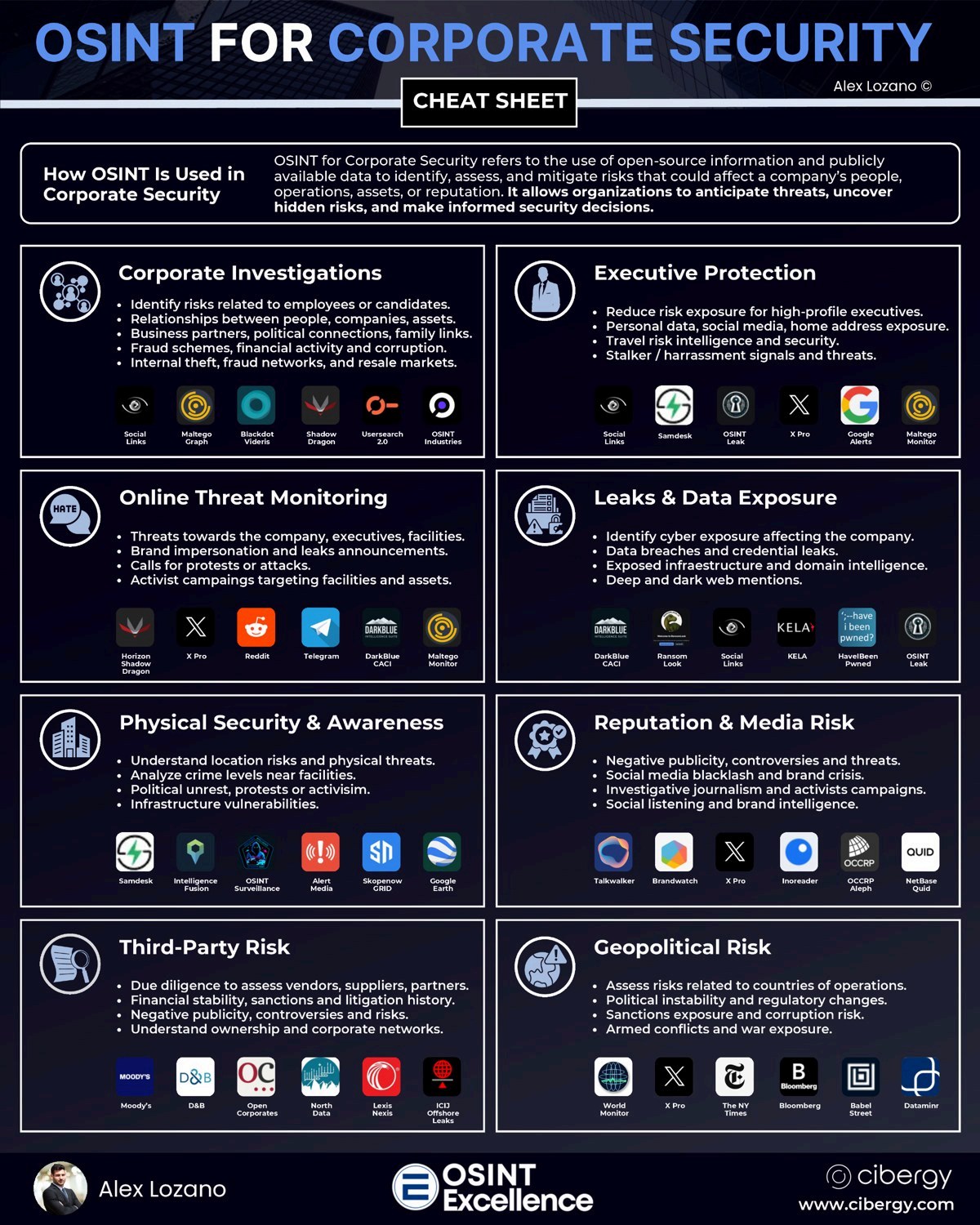
1. Corporate investigations
The pain. Fraud, conflicts of interest and internal theft rarely announce themselves. By the time an anomaly shows up in the accounts, the losses have often been running for months and the people involved have had time to cover their tracks.
The OSINT answer. Open sources let investigators map the people, companies and assets behind a suspicion, using registries, social media, court records and leaks, quickly and without alerting the subjects. A hunch becomes a documented network of connections. Typical uses include:
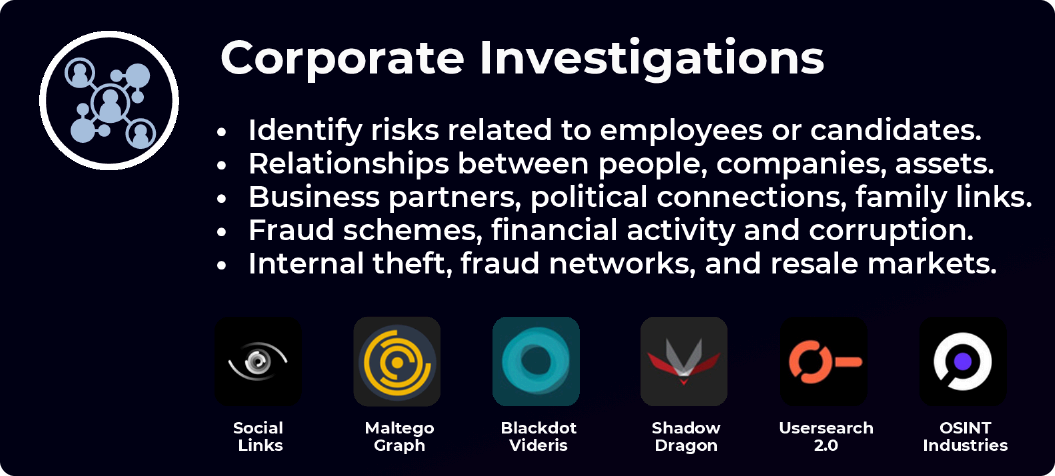
- Identifying risks related to employees or candidates (within the limits of employment and privacy law).
- Mapping relationships between people, companies and assets.
- Uncovering business partners, political connections and family links.
- Detecting fraud schemes, suspicious financial activity and corruption.
- Tracing internal theft, fraud networks and resale markets for stolen goods.
Tools on the cheat sheet: Social Links, Maltego Graph, Blackdot Videris, ShadowDragon, Usersearch 2.0 and OSINT Industries. Link analysis platforms like these are particularly valuable here because corporate fraud is usually about connections: the employee who is also a director of the supplier, or the supplier who shares an address with a competitor.
2. Executive protection
The pain. A CEO’s home address, family photos and travel plans are often only a few searches away. Criminals, stalkers and activists know it, and most executives underestimate how much of their life is exposed.
The OSINT answer. OSINT for executive security gives protection teams the attacker’s view: a map of what is public about the principal and their family, plus continuous monitoring of hostile mentions. Exposure can then be reduced before anyone exploits it. It helps to:
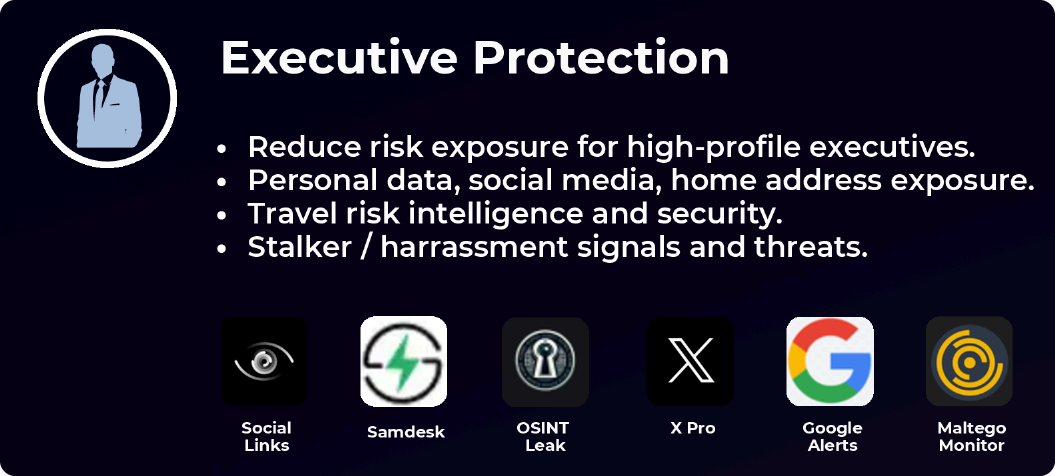
- Reduce risk exposure for high-profile executives.
- Find exposed personal data, social media and home addresses.
- Provide travel risk intelligence.
- Detect stalking and harassment signals and threats.
Osint Tools For Executive Protection: Social Links, Samdesk, OSINT Leak, X Pro, Google Alerts and Maltego Monitor. We cover this topic in depth in Part 10 of this series.
3. Online threat monitoring
The pain. Threats against companies are increasingly announced online first: a call to protest, a threat against an executive, a fake profile impersonating the brand. Without monitoring, security teams find out once the incident has already happened.
The OSINT answer. Structured monitoring of social networks, forums and messaging channels detects these signals early and turns them into alerts with context, so the team can assess and act in time. It covers:
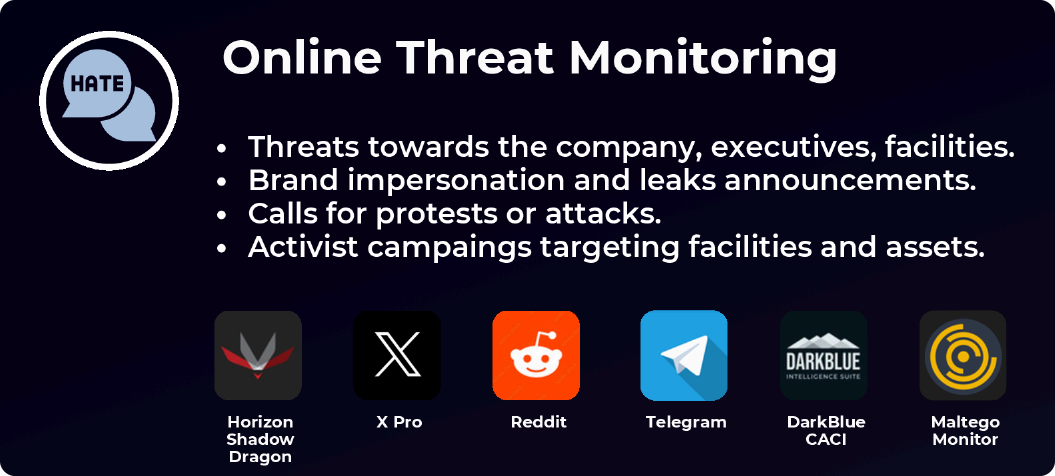
- Threats against the company, executives and facilities.
- Brand impersonation and announcements of data leaks.
- Calls for protests or attacks.
- Activist campaigns targeting facilities and assets.
Tools: ShadowDragon Horizon, X Pro, Reddit, Telegram, DarkBlue (CACI) and Maltego Monitor. The challenge here is not collection but signal-to-noise ratio. A good monitoring programme defines clear keywords, thresholds and escalation paths so analysts are not overwhelmed by irrelevant mentions.
4. Leaks and data exposure
The pain. Stolen credentials, leaked documents and exposed servers are the raw material of most cyberattacks. They often circulate on forums and leak sites long before the company realises anything is wrong.
The OSINT answer. OSINT and dark web monitoring reveal what attackers can already see about the organisation. Passwords can be reset, systems closed and leaks contained before they are exploited. Key areas are:
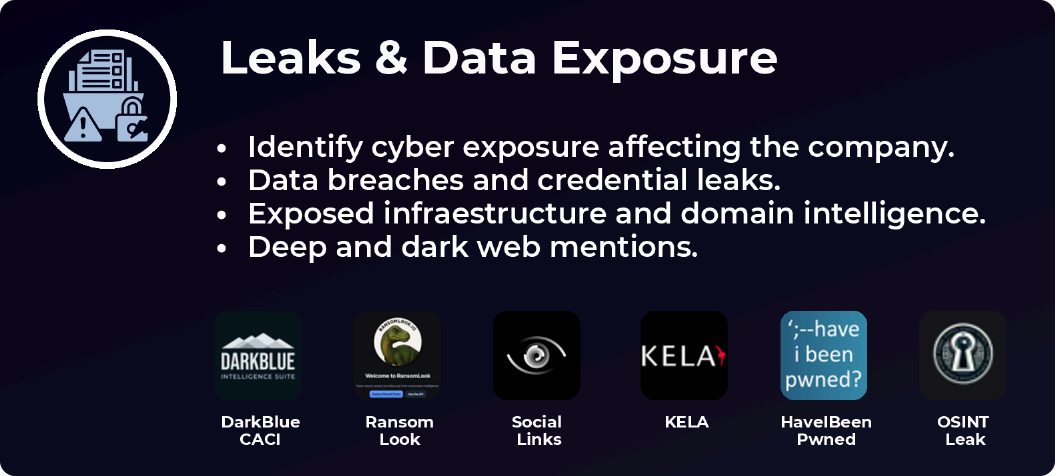
- Identifying cyber exposure affecting the company.
- Detecting data breaches and credential leaks.
- Mapping exposed infrastructure and domain intelligence.
- Monitoring deep and dark web mentions.
Osint Tools for Data Exposure: DarkBlue (CACI), RansomLook, Social Links, KELA, Have I Been Pwned and OSINT Leak. A practical quick win is to monitor corporate email domains for appearances in breach data, then force password resets and enforce multi-factor authentication for exposed accounts.
5. Physical security and awareness
The pain. Offices, warehouses, stores and events sit in real neighbourhoods with real risks: crime, protests, unrest or fragile infrastructure. Yet decisions about sites, events and travel are often made with little information about that environment.
The OSINT answer. Open sources give security managers a current picture of the area around each location, from local news and crime data to social media and satellite imagery. It supports:
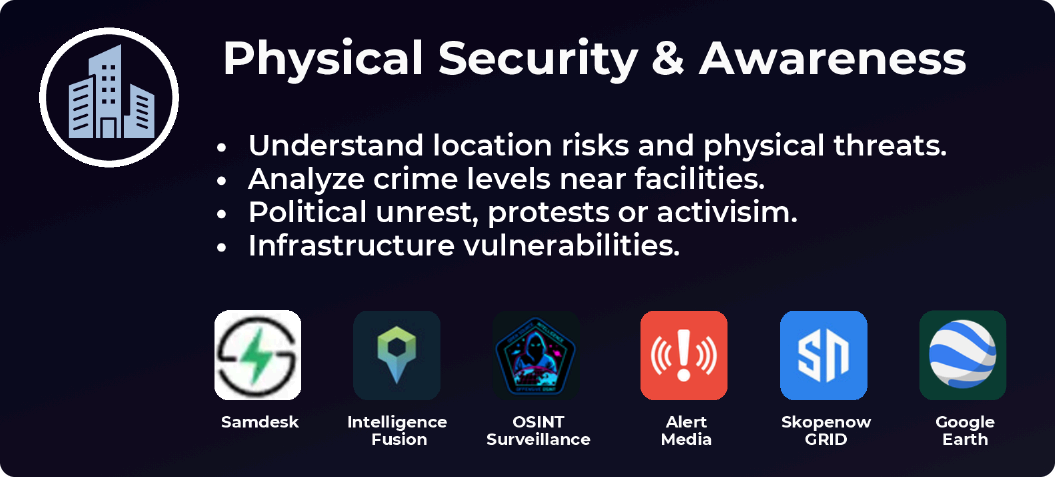
- Understanding location risks and physical threats.
- Analysing crime levels near facilities.
- Tracking political unrest, protests or activism.
- Identifying infrastructure vulnerabilities.
Tools: Samdesk, Intelligence Fusion, OSINT Surveillance, AlertMedia, Skopenow GRID and Google Earth. Before opening an office or hosting an event, a short OSINT assessment of the surrounding area can change decisions about access control, parking or staff travel routes.
6. Reputation and media risk
The pain. A viral post, a critical investigation or an activist campaign can damage a brand within hours, and the first warning is often a journalist’s call. Reacting late means losing control of the story.
The OSINT answer. Social listening and media monitoring based on open sources detect emerging controversies early and show who is driving them. Communications and security teams gain time to respond. It focuses on:
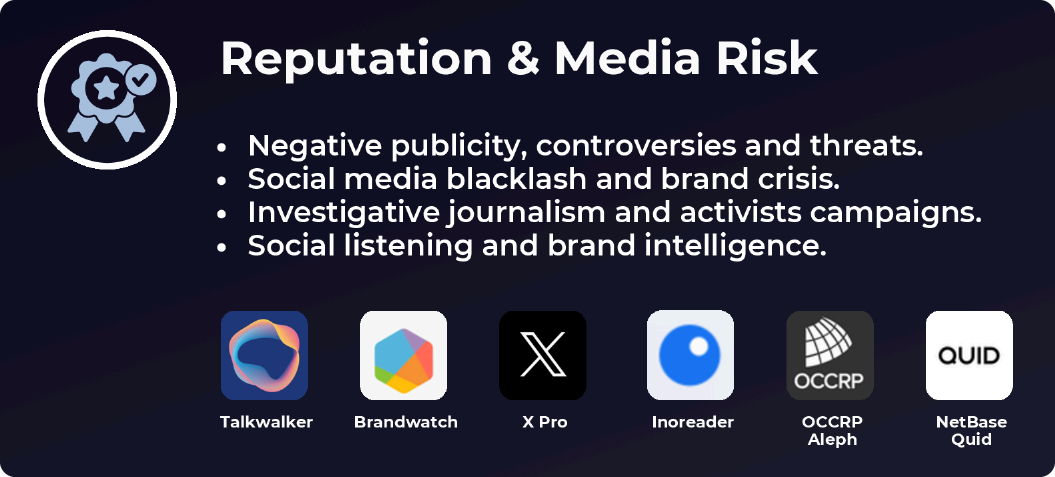
- Negative publicity, controversies and threats.
- Social media backlash and brand crises.
- Investigative journalism and activist campaigns.
- Social listening and brand intelligence.
Tools: Talkwalker, Brandwatch, X Pro, Inoreader, OCCRP Aleph and NetBase Quid. Security and communications teams benefit from sharing the same monitoring picture, because many reputational crises have a security dimension and vice versa.
7. Third-party risk
The pain. Suppliers, partners and distributors bring their own risks into the company: insolvency, sanctions, corruption or hidden owners. Many organisations only discover them when a contract goes wrong or a regulator starts asking questions.
The OSINT answer. OSINT due diligence combines company registries, financial data, litigation records, media and leak databases to reveal who is really behind a third party and how risky they are, before the contract is signed. It covers:
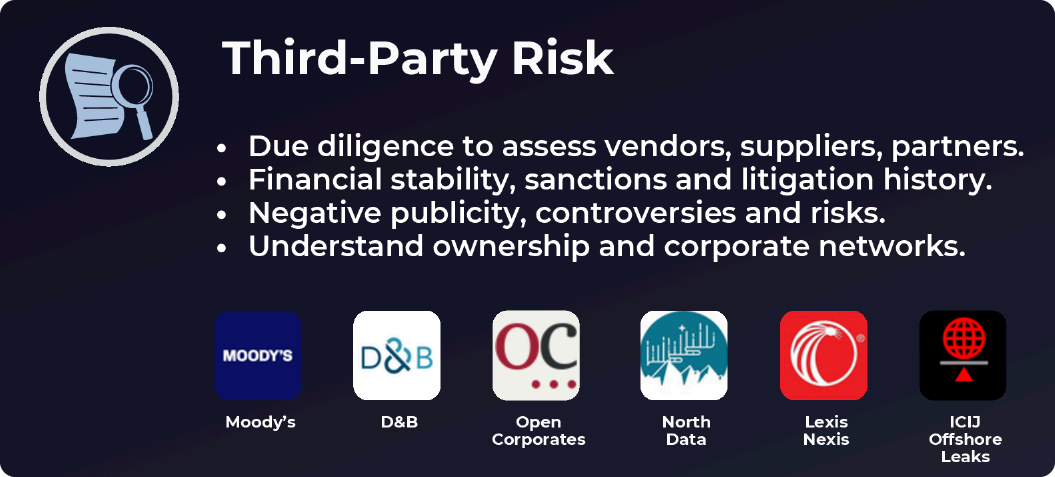
- Assessing vendors, suppliers and partners.
- Checking financial stability, sanctions and litigation history.
- Identifying negative publicity, controversies and risks.
- Understanding ownership and corporate networks, including ultimate beneficial owners.
Tools: Moody’s, Dun & Bradstreet, OpenCorporates, NorthData, LexisNexis and the ICIJ Offshore Leaks database. A combination of commercial databases and free sources often gives the best picture: commercial data for structured financial information, open sources for the context that databases miss.
8. Geopolitical risk
The pain. Elections, conflicts, sanctions and sudden regulatory changes can disrupt operations, supply chains and staff safety overnight. Generic news coverage rarely tells a company what an event means for its own people and assets.
The OSINT answer. OSINT turns open news, social media and official sources into risk assessments tailored to the countries where the company operates, with early warning when the situation changes. It covers:
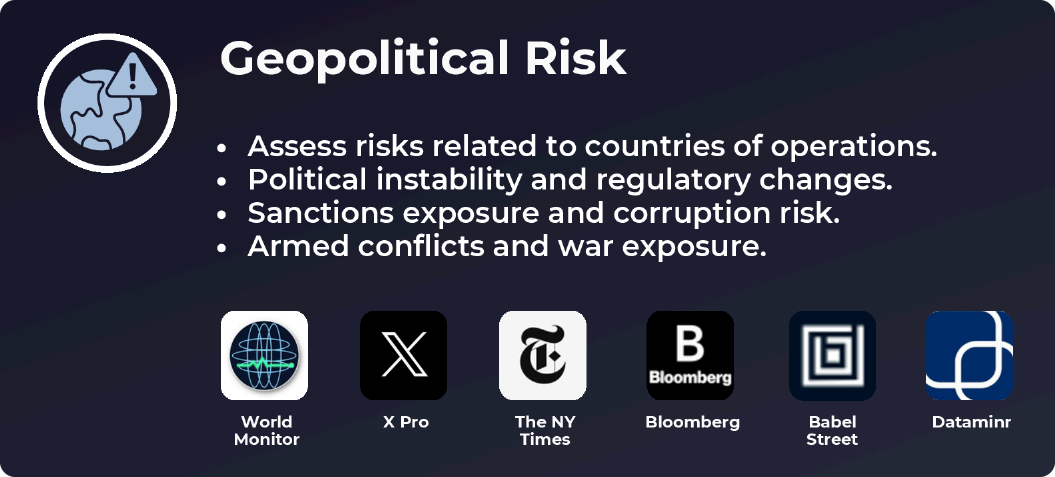
- Assessing risks in countries of operation.
- Monitoring political instability and regulatory changes.
- Evaluating sanctions exposure and corruption risk.
- Tracking armed conflicts and war exposure.
Tools: World Monitor, X Pro, The New York Times, Bloomberg, Babel Street and Dataminr. Geopolitical OSINT turns news flow into business-relevant assessments: what does this election, conflict or new regulation mean for our people, sites and contracts?
How to build a corporate OSINT capability
The eight use cases can feel overwhelming. Most organisations start small and grow:
- Prioritise. Pick the two or three use cases with the highest risk for your business. For a logistics firm that may be third-party risk and physical security. For a listed company, executive protection and leaks.
- Define intelligence requirements. What questions must the programme answer, for whom, and how often?
- Set the legal framework. Work with legal and data protection teams. In Europe, GDPR principles such as legitimate interest, proportionality and data minimisation apply, and employee screening is strictly regulated.
- Combine tools and people. Platforms accelerate collection, but trained analysts produce the assessments. Budget for both.
- Measure value. Track incidents anticipated, risky suppliers flagged, exposure reduced. This is what secures the budget for next year.
- Outsource where it makes sense. Specialised investigations, dark web monitoring or one-off due diligence are often more efficient with an external provider.
Final thought about OSINT for corporate security
Corporate security has traditionally been reactive: respond to the incident, investigate, recover. OSINT shifts the balance towards anticipation. The information is usually out there. The question is whether your organisation is looking.
In Part 9 we look at how law enforcement and public safety agencies apply OSINT to prevention, real-time monitoring and investigations.
Want to go deeper? Download the full OSINT Cheat Sheets collection and explore the training programmes at OSINT Excellence, or contact Cibergy for professional open source investigations.
Frequently asked questions (FAQs)
What is OSINT for corporate security?
OSINT for corporate security is the use of open-source information and publicly available data to identify, assess and mitigate risks to a company’s people, operations, assets or reputation. It allows organisations to anticipate threats, uncover hidden risks and make informed security decisions.
What are the main use cases of OSINT in corporate security?
There are eight: corporate investigations, executive protection, online threat monitoring, leaks and data exposure, physical security and awareness, reputation and media risk, third-party risk and geopolitical risk. Each one covers a different type of risk and has its own set of tools.
How does OSINT help protect executives?
It gives protection teams the attacker’s view: a map of the personal data, social media and home addresses that are public about the executive and their family, plus continuous monitoring of hostile mentions, stalking and harassment signals. Exposure can then be reduced before anyone exploits it.
Which OSINT security tools are used in corporate security?
The tools depend on the use case. Link analysis platforms such as Maltego Graph, Social Links and ShadowDragon support investigations. X Pro, Reddit, Telegram and DarkBlue support threat monitoring. Have I Been Pwned and KELA cover leaks, and Moody’s, Dun & Bradstreet, OpenCorporates and NorthData support third-party checks. The best picture usually combines commercial databases with free sources.
How can a company detect leaked credentials with OSINT?
A practical quick win is to monitor corporate email domains for appearances in breach data, then force password resets and enforce multi-factor authentication for exposed accounts. Dark web monitoring adds visibility of what attackers can already see about the organisation.
How do you build a corporate OSINT capability?
Start small: prioritise the two or three use cases with the highest risk, define the intelligence requirements, set the legal framework, combine tools and trained analysts, measure value and outsource specialised work where it makes sense.
Does OSINT have to comply with data protection rules?
Yes. In Europe, GDPR principles such as legitimate interest, proportionality and data minimisation apply, and employee screening is strictly regulated. Legal and data protection teams should therefore be involved from the start.
Summary
OSINT for corporate security uses open-source information to anticipate threats, uncover hidden risks and support informed security decisions. The cheat sheet covers eight use cases, each with its own OSINT security tools, and the best way to start is to prioritise the two or three that carry the most risk for your business.
- Corporate investigations: map the people, companies and assets behind fraud, conflicts of interest and internal theft.
- Executive protection: reduce the public exposure of executives and detect harassment signals.
- Online threat monitoring: detect threats, brand impersonation and calls for protests early.
- Leaks and data exposure: find breached credentials and exposed infrastructure before attackers use them.
- Physical security and awareness: get a current picture of crime, unrest and infrastructure risks near each site.
- Reputation and media risk: spot emerging controversies before they become a crisis.
- Third-party risk: reveal financial, sanctions and ownership risks before a contract is signed.
- Geopolitical risk: turn news flow into assessments for the countries where the company operates.