
Before anyone approaches an executive in a car park, at their home or outside their child’s school, they usually do some research. Where does this person live? What car do they drive? Where will they be next week? Who are their family members? In many cases, the answers are only a few searches away.
Executive protection has always been about anticipating threats. OSINT adds a powerful capability: seeing the protected person’s digital exposure the way an adversary would, and closing the gaps before they are exploited. Integrating OSINT into protection strategies gives security teams valuable intelligence to proactively mitigate risks and keep the principal safe.
This article walks through The OSINT Cheat Sheet for Executive Protection step by step, starting with the executive digital footprint an attacker can see.
At Cibergy, an intelligence and fraud consulting firm, we tell you everything you need to know about OSINT for executive protection and the executive digital footprint, step by step.
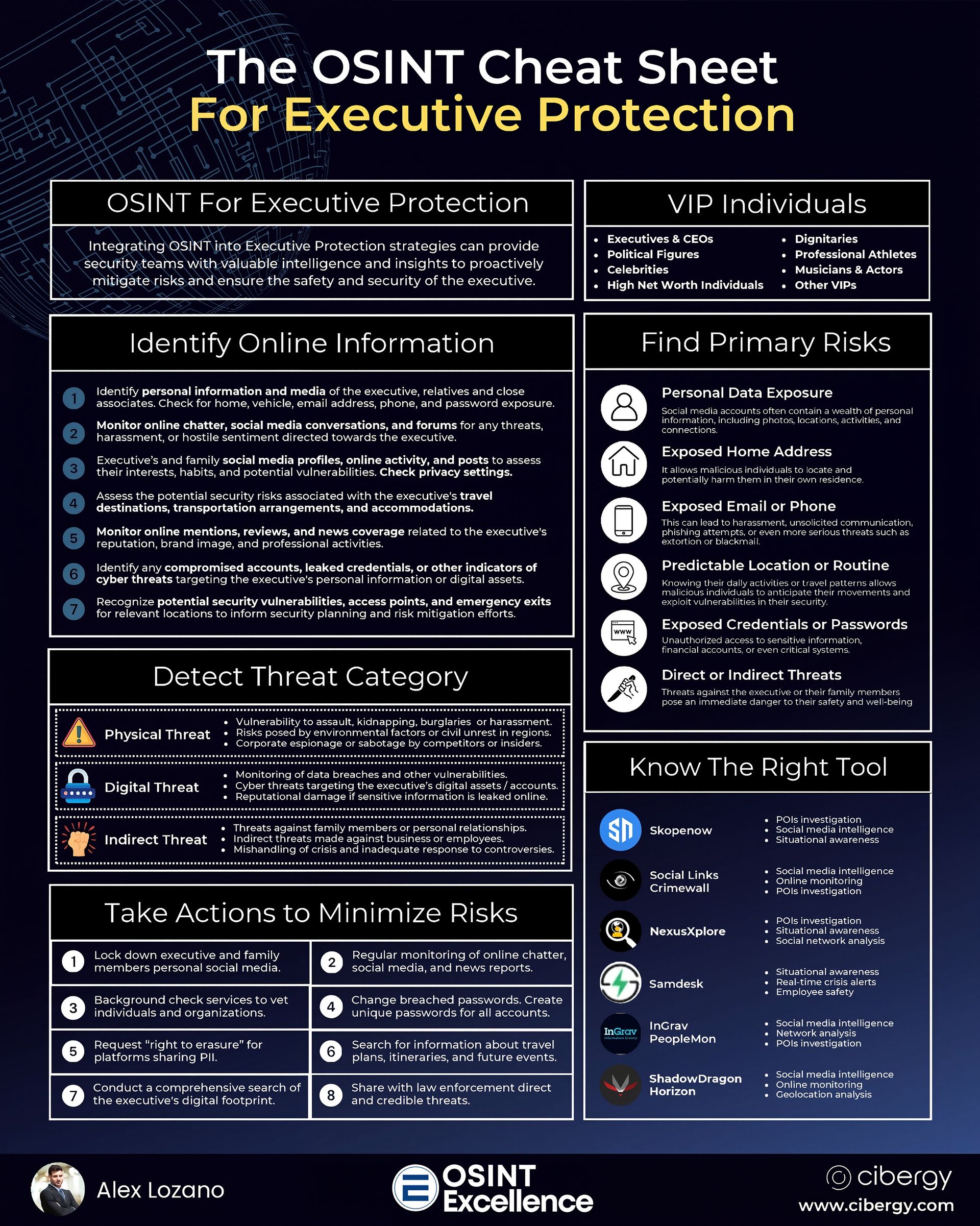
Who needs OSINT-driven protection
The cheat sheet lists the typical profiles: executives and CEOs, political figures, celebrities, high net worth individuals, dignitaries, professional athletes, musicians and actors, and other VIPs.

What they share is visibility. Their name is public, their schedule is often partially public and their families are frequently mentioned in the media or on social networks. Visibility creates exposure, and exposure creates risk.
Step 1: Identify online information and the executive digital footprint
The first phase is a structured executive digital footprint assessment. The cheat sheet outlines seven areas:
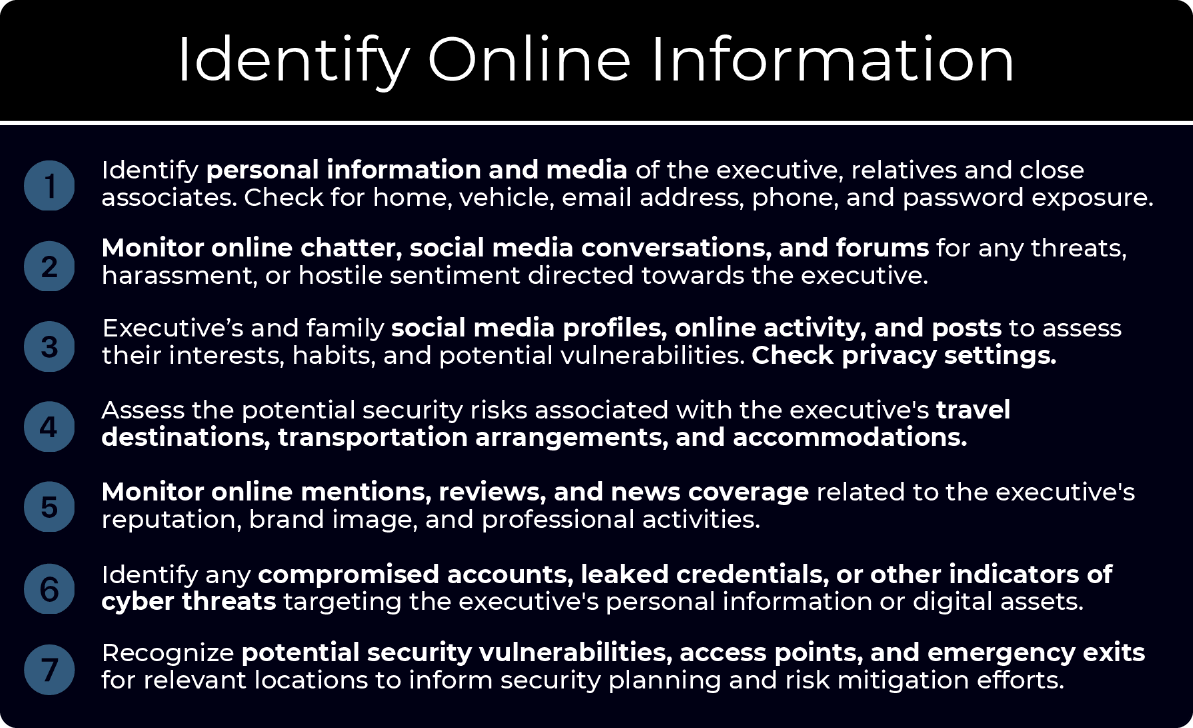
- Personal information and media of the executive, relatives and close associates: home address, vehicles, personal email, phone numbers and any exposed passwords.
- Online chatter, social media conversations and forums that contain threats, harassment or hostile sentiment towards the executive.
- Social media profiles and activity of the executive and their family, to understand interests, habits and vulnerabilities, including a review of privacy settings.
- Travel risks: destinations, transport arrangements and accommodation.
- Online mentions, reviews and news coverage related to their reputation, brand image and professional activity.
- Compromised accounts, leaked credentials or other indicators of cyber threats against their personal information or digital assets.
- Security vulnerabilities, access points and emergency exits at relevant locations, to inform security planning.
The family dimension is critical. Executives are often well advised about their own privacy. Their teenage children, their spouse’s public fitness app or a relative’s proud post about “our new holiday home” are frequently where exposure leaks.
Step 2: Find the primary risks
The cheat sheet summarises six primary risks that a footprint assessment typically uncovers:
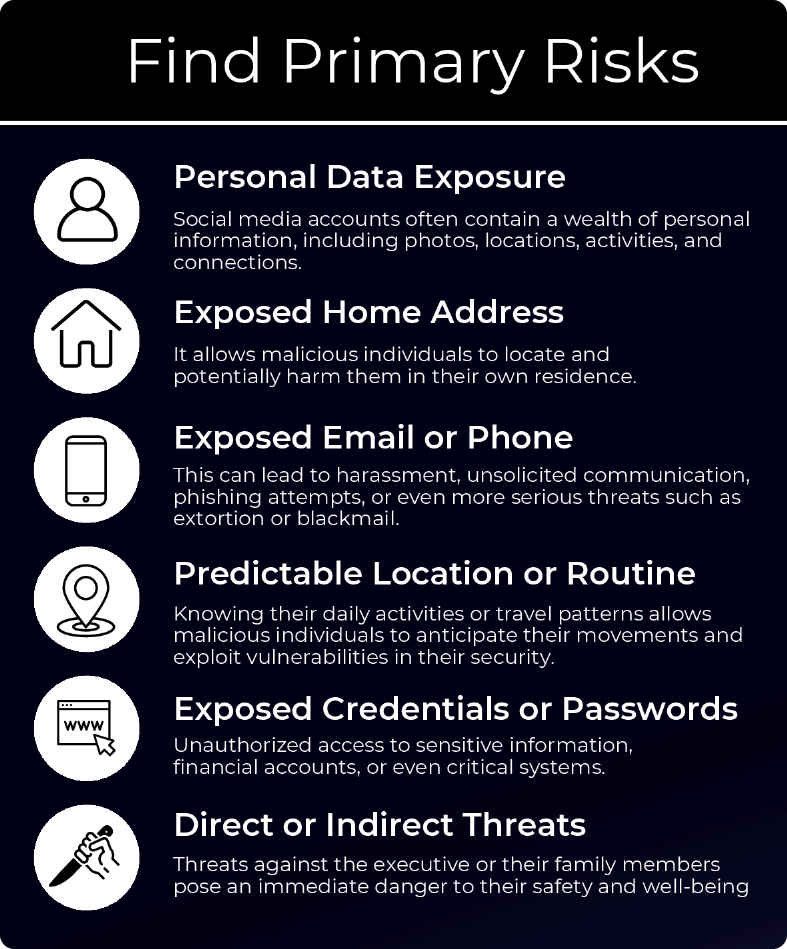
| Risk | Why it matters |
|---|---|
| Personal data exposure | Social media often reveals photos, locations, activities and connections |
| Exposed home address | Allows malicious individuals to locate and harm the principal at their residence |
| Exposed email or phone | Enables harassment, phishing, extortion or blackmail |
| Predictable location or routine | Lets adversaries anticipate movements and exploit security gaps |
| Exposed credentials or passwords | Opens access to sensitive information, financial accounts or critical systems |
| Direct or indirect threats | Threats against the executive or family pose an immediate danger |
Predictable routine is the risk most often underestimated. A weekly running route shared through a fitness app, a regular Saturday restaurant check-in or a child’s sports fixtures published by a club can reveal patterns as clearly as any surveillance.
Step 3: Detect the threat category
Not all threats are alike. The cheat sheet classifies them into three categories, each requiring a different response.
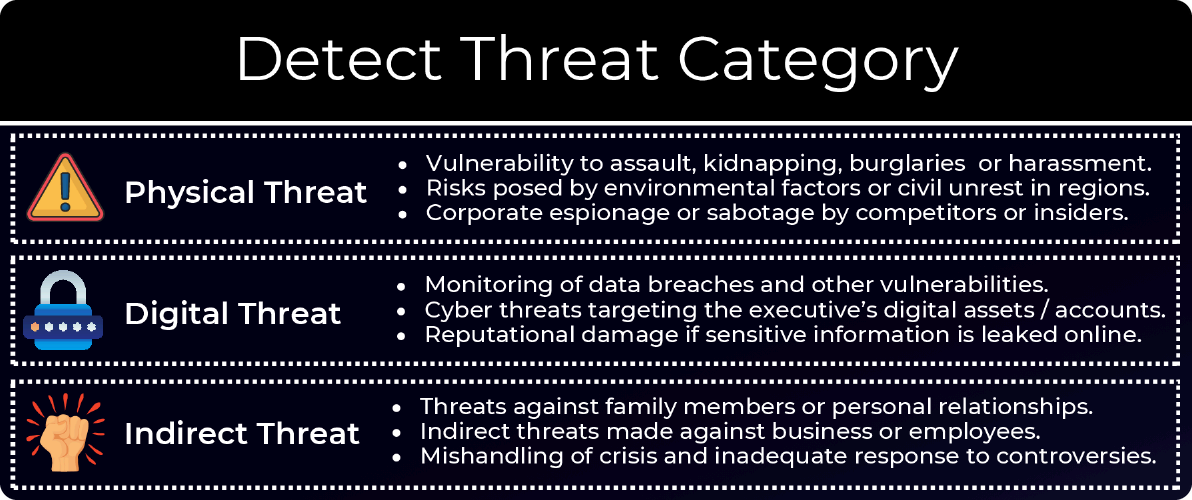
Physical threats. Vulnerability to assault, kidnapping, burglary or harassment. Risks from environmental factors or civil unrest in a region. Corporate espionage or sabotage by competitors or insiders.
Digital threats. Data breaches and other vulnerabilities. Cyber threats targeting the executive’s accounts and digital assets. Reputational damage if sensitive information is leaked online.
Indirect threats. Threats against family members or personal relationships. Threats against the business or its employees that may escalate to the executive. Poor crisis management or inadequate responses to controversies that turn public anger towards a person.
Classifying a threat correctly determines who acts: the protection detail, the cybersecurity team, communications, legal or law enforcement.
Step 4: Take action to minimise risk
Identifying exposure is only useful if it leads to action. The cheat sheet lists eight measures:
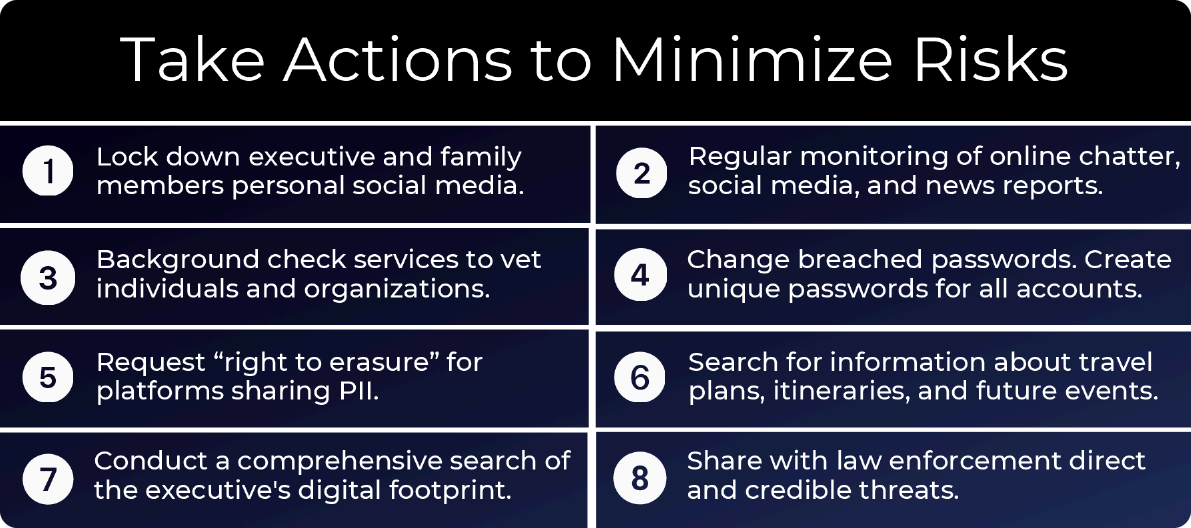
- Lock down the social media of the executive and family members.
- Monitor online chatter, social media and news reports on a regular basis.
- Use background check services to vet individuals and organisations around the principal.
- Change breached passwords and create unique passwords for every account.
- Request the “right to erasure” from platforms sharing personal information. In the EU this is grounded in Article 17 of the GDPR, and in other jurisdictions data broker opt-out processes serve a similar purpose.
- Search for information about travel plans, itineraries and future events before they happen.
- Conduct a comprehensive search of the executive’s digital footprint, and repeat it periodically.
- Share direct and credible threats with law enforcement.
Two points from practice. First, remediation is a process, not a one-off clean-up. Data reappears, new accounts are created and family members post again. Second, communication matters: executives and families are more likely to change habits when they see their own exposure demonstrated with real examples, not abstract warnings.
Step 5: Know the right tool
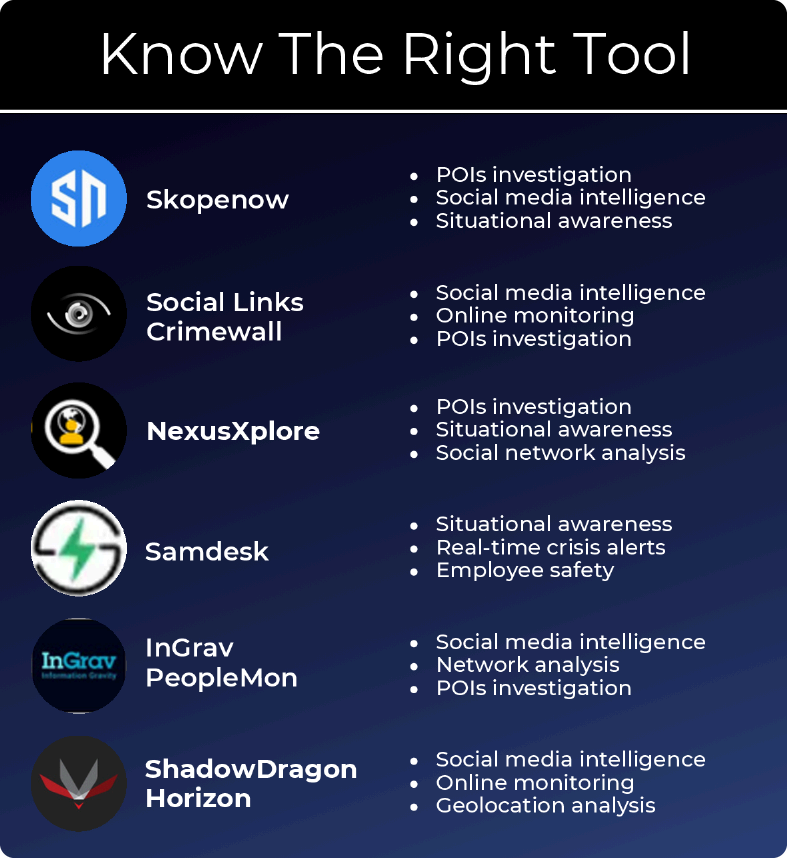
Protection teams increasingly rely on specialised platforms. The cheat sheet highlights six:
| Tool | Main uses |
|---|---|
| Skopenow | Person of interest investigations, social media intelligence, situational awareness |
| Social Links Crimewall | Social media intelligence, online monitoring, person of interest investigations |
| NexusXplore | Person of interest investigations, situational awareness, social network analysis |
| Samdesk | Situational awareness, real-time crisis alerts, employee safety |
| InGrav PeopleMon | Social media intelligence, network analysis, person of interest investigations |
| ShadowDragon Horizon | Social media intelligence, online monitoring, geolocation analysis |
Tools accelerate collection and monitoring, but they do not replace the analyst. Judging whether a hostile post is venting or a credible threat requires context, experience and often consultation with threat assessment specialists.
An illustrative scenario
Imagine a CEO who keeps a deliberately low profile online. A footprint assessment finds no personal social media. But it does find a property registry entry linking the CEO’s name to a residential address, a spouse’s public fitness profile showing a daily 7 a.m. running route starting at that address, and a local sports club website listing the children’s weekend match schedule.
None of these sources is sensitive on its own. Combined, they give anyone a home address, a predictable daily routine and the weekly location of the children. That combination is exactly what OSINT for executive protection is designed to uncover and reduce.
Building an executive protection OSINT programme
- Baseline: a full footprint assessment of the principal and close family.
- Remediation: privacy settings, removal requests, password changes and family awareness sessions.
- Monitoring: continuous alerts on threats, mentions and leaked data.
- Advance work: OSINT on every trip, venue and public appearance.
- Review: a repeat assessment every six to twelve months, or after any major public event.
All of this must be done with the principal’s consent and within data protection law, especially when it involves family members.
Final thought
The most effective protection happens before anyone is in danger. By looking at an executive the way an adversary would, OSINT turns invisible exposure into concrete, fixable risks. It is one of the clearest examples of what open source intelligence does best: providing time and options before a problem becomes a crisis.
This article closes the first ten instalments of our OSINT Cheat Sheets series.
Want to go deeper? Download the full OSINT Cheat Sheets collection and explore the training programmes at OSINT Excellence, or contact Cibergy for professional open source investigations.
Frequently asked questions (FAQs)
What is OSINT for executive protection?
OSINT for executive protection is the use of open source intelligence to see a protected person’s digital exposure the way an adversary would, and to close the gaps before they are exploited. It gives security teams valuable intelligence to mitigate risks proactively. It applies to executives and CEOs, political figures, celebrities, high net worth individuals, dignitaries, professional athletes, musicians and actors, and other VIPs, all of whom share high visibility.
What does an executive digital footprint assessment cover?
An executive digital footprint assessment covers seven areas: personal information and media of the executive, relatives and close associates; online chatter and hostile sentiment; social media profiles and privacy settings; travel destinations, transport and accommodation; mentions, reviews and news coverage; compromised accounts and leaked credentials; and security vulnerabilities, access points and emergency exits at relevant locations. The family is a critical part of it, because teenage children, a spouse’s fitness app or a relative’s post are frequent sources of leaks.
Which are the primary risks an assessment finds?
A footprint assessment typically uncovers six primary risks: personal data exposure, an exposed home address, an exposed email or phone, a predictable location or routine, exposed credentials or passwords, and direct or indirect threats. The predictable routine is the one most often underestimated, because a running route shared through a fitness app or a child’s sports fixtures can reveal patterns as clearly as surveillance.
What are the three threat categories?
Threats fall into three categories: physical (assault, kidnapping, burglary, harassment, civil unrest, corporate espionage or sabotage), digital (data breaches, cyber threats against accounts and reputational damage from leaks) and indirect (threats against family members, the business or its employees, and poor crisis management). Classifying a threat correctly determines who acts: the protection detail, the cybersecurity team, communications, legal or law enforcement.
What actions reduce an executive’s exposure?
Eight measures reduce exposure: locking down the social media of the executive and family, monitoring online chatter regularly, using background check services to vet people and organisations around the principal, changing breached passwords, requesting the right to erasure from platforms that share personal information, searching for travel plans and future events before they happen, repeating a comprehensive footprint search periodically and sharing direct and credible threats with law enforcement. Remediation is a process, not a one-off clean-up, because data reappears and family members post again.
Which tools do protection teams use?
The cheat sheet highlights six platforms: Skopenow, Social Links Crimewall, NexusXplore, Samdesk, InGrav PeopleMon and ShadowDragon Horizon. They cover person of interest investigations, social media intelligence, online monitoring, situational awareness, real-time crisis alerts, network analysis and geolocation analysis. They accelerate collection and monitoring but do not replace the analyst, who judges whether a hostile post is venting or a credible threat.
Does OSINT for executive protection need consent?
Yes. An executive protection OSINT programme must be carried out with the principal’s consent and within data protection law, especially when it involves family members. In the EU, the right to erasure is grounded in Article 17 of the GDPR, and in other jurisdictions data broker opt-out processes serve a similar purpose.
Summary
OSINT for executive protection means looking at an executive the way an adversary would, so that invisible exposure becomes concrete, fixable risks. The cheat sheet follows five steps, from the footprint assessment to the tools, and the work is a continuous programme, not a one-off clean-up.
- Executive digital footprint: assess seven areas of online information about the executive, relatives and close associates.
- Risks: six primary risks, with the predictable routine as the most underestimated.
- Threat categories: physical, digital and indirect, each requiring a different response.
- Actions: eight measures, from locking down social media to sharing credible threats with law enforcement.
- Tools: six platforms that accelerate collection and monitoring without replacing the analyst.
- Programme: baseline, remediation, monitoring, advance work and a repeat assessment every six to twelve months.
- Consent: carried out with the principal’s consent and within data protection law.